
How to measure a room for carpet installation
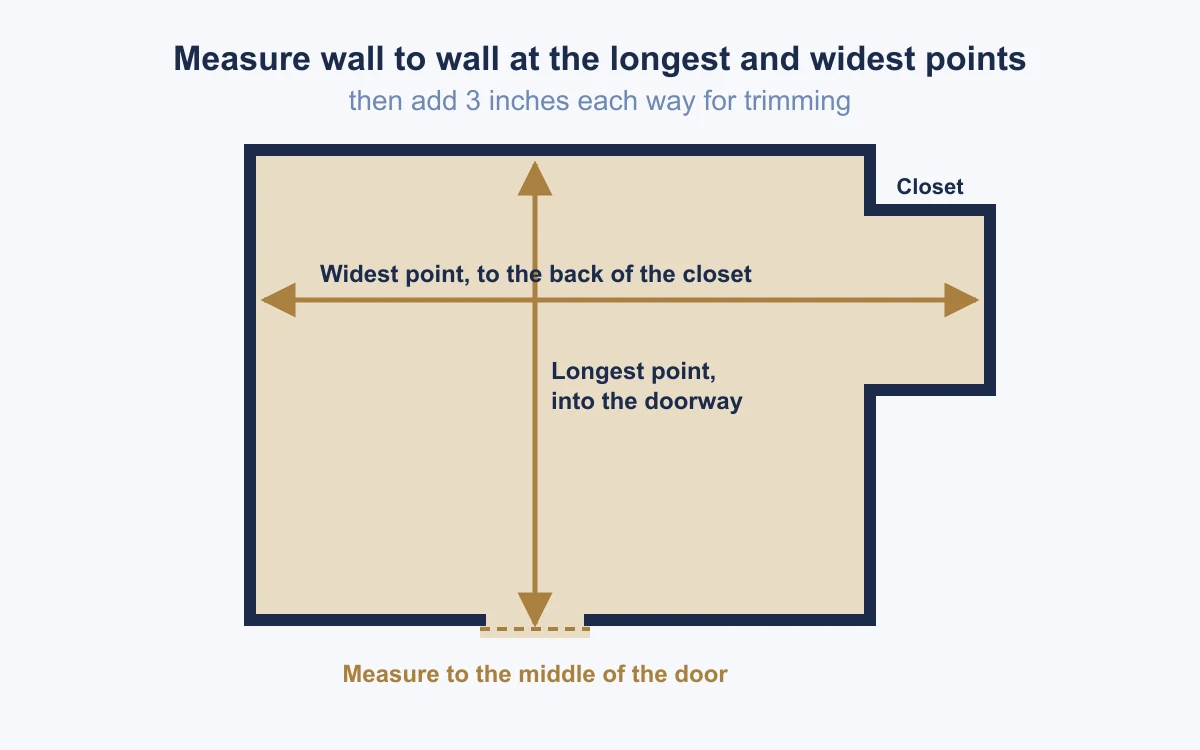
Measure the room wall to wall at its longest and widest points, into each doorway to the middle of the door and to the back of every closet, then add 3 inches along each wall for trimming. Carpet comes off a roll 12 feet wide, so a room wider than that needs a second piece and a seam.
I’m Wayne Carlson. I’ve installed carpet around Mission, Maple Ridge, Abbotsford and Pitt Meadows for 34 years, and at every measure I tell people how much to buy, almost to the exact amount, so they walk into the store with one number instead of three.
Measuring for carpet looks like the easiest job in the house, right up until the store asks for “the square footage” and you realize you measured the bedroom by walking it heel to toe and counting under your breath.
On this pageHow much carpet do common rooms take off a 12-foot roll?
A room takes a 12-foot-wide piece as long as the room, plus 3 inches of trim at each end. Rooms 12 feet wide or less take one piece. Wider rooms take two pieces and a seam. These figures use the simplest layout: whole lengths, laid whichever way uses less carpet, no offcuts reused.
Divide square feet by 9 for square yards: Canada’s Weights and Measures Act sets a square foot at one ninth of a square yard. The 13 by 15 room isn’t a typo. It’s 1 foot too wide for the roll, which makes that foot the most expensive one in the house.
What do you need to measure a room for carpet?
You need a 25-foot metal tape measure, a pencil, paper and the calculator on your phone. A second person helps on anything longer than about 15 feet.
Use the metal tape, not the cloth one from the sewing drawer, which has been quietly stretching since 1998 and will lie to you. The second person’s job is to hold the far end, which the tape will let go of the exact second you’re reading the number.
How do you measure a room for carpet, step by step?
Sketch the room, measure wall to wall at the longest and widest points, measure into the doorways and closets, then add 3 inches at each wall. The carpet industry’s residential installation standard asks for at least 3 inches of extra carpet along each wall so the edges can be trimmed clean.
Rather skip the tape? Working out the measure is the first thing I do on a carpet replacement job, and it’s free in Mission, Maple Ridge, Abbotsford and Pitt Meadows.
Why does a 12-foot roll change how much carpet you buy?
Carpet is sold off rolls, and the most common width is 12 feet, so you buy the full width for whatever length you need. A room under 12 feet wide wastes the spare width. A room over it needs a second piece, and you pay for most of that second width even when the room only needs a strip of it.
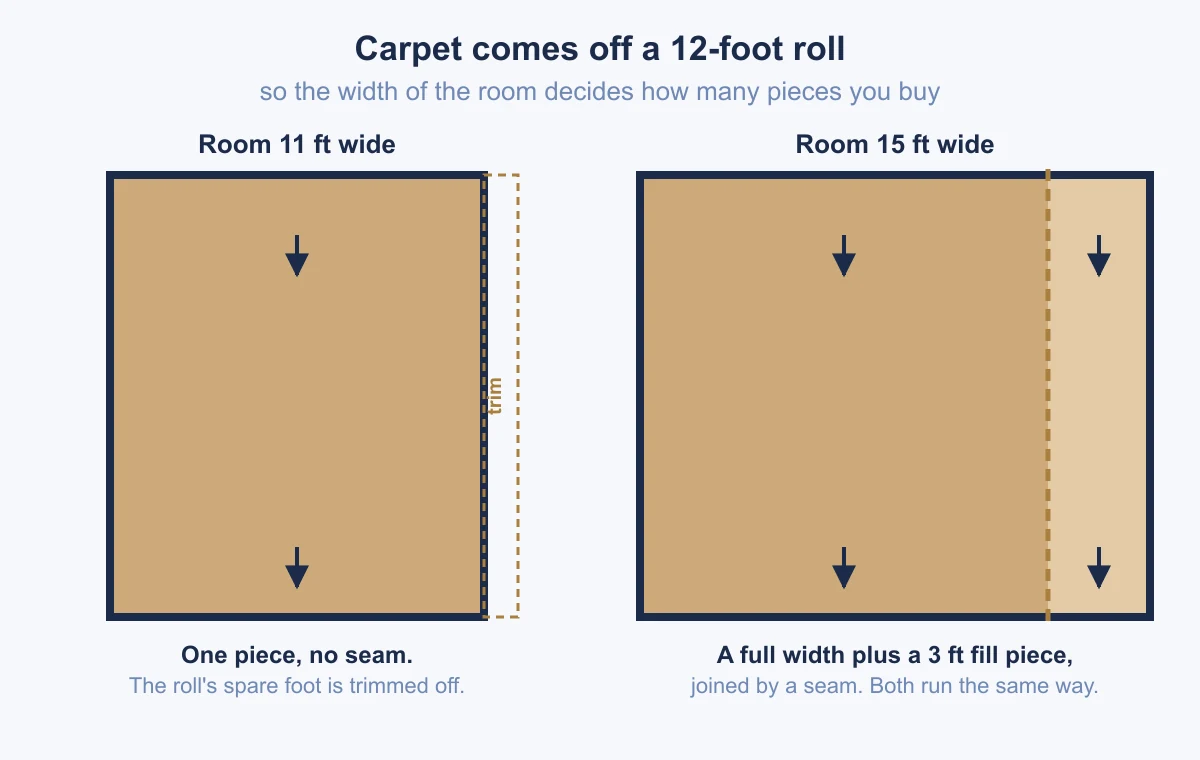
Most guides say to add 10% for waste, and one consumer advocate says the extra shouldn’t top 10%. The 10% rule is the carpet version of “this’ll only take five minutes”: said with total confidence, and right about once a year. A 10 by 10 room needs 26% more carpet than its floor. A 13 by 15 room needs 66% more.
The 2 feet of width a 10-foot room doesn’t need comes off with a knife and goes to the garage, where it joins the other carpet scraps your family is keeping “just in case” and has never once used.
An installer can often bring a big room down by cutting the fill piece from another room’s leftover, or splitting it into shorter pieces with more seams. That trade between seams and carpet is why three quotes for one upstairs came in at about 1,200, 1,400 and 1,600 square feet: three numbers, and one homeowner wondering if the house grew between visits. Ask each one to show you the layout, as Consumers’ Checkbook advises.
Where do the seams go in a carpeted room?
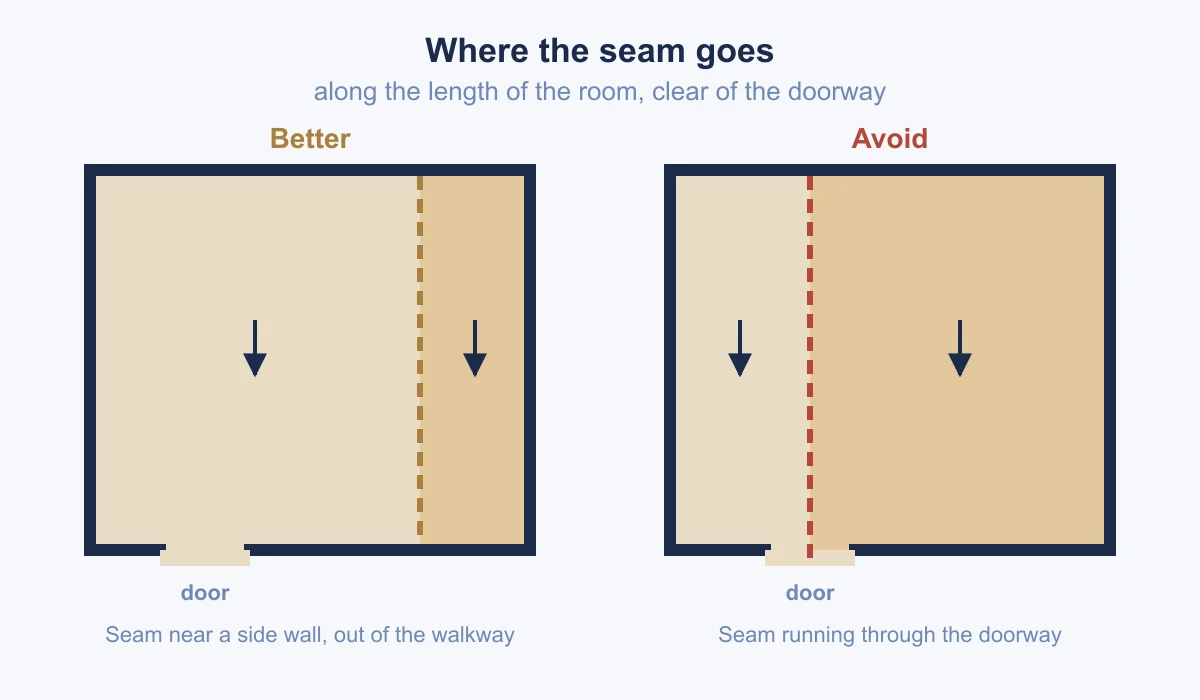
Seams go where you’ll notice them least: along the length of the room, with foot traffic running along them, not across, and never through a doorway. Every piece runs the same direction, because carpet turned even a quarter turn reads as a different colour. The industry standard says a properly made seam will not be invisible.
Sometimes a seam looks like two colours even when it’s done right. The dye can run uneven across the width of a roll, so two pieces of the same carpet come out a shade apart. It’s called side-to-side shading, and it comes from the manufacturer. When it happens, I photograph it and take it to the store, and it gets replaced through the manufacturer’s warranty.
The customer looks at the seam, then at me. I look at the roll. The roll says nothing, because it’s a roll, and it has never once taken responsibility for anything.
“It’s called side to side shading. It comes from the manufacturer.”Wayne Carlson
How long does carpet installation take?
Most rooms are done in a day. HomeGuide puts an average room at 4 to 8 hours. The industry standard also has the carpet sit in the house for at least 24 hours first, so it settles to the room. These are what add time, by Angi’s numbers:
The carpet itself goes down fast. What takes the time is everything sitting on the old carpet: the bed, the dresser, and the treadmill that has been working as a clothes rack since 2021. We can move the furniture, priced at the measure. The treadmill’s emotional baggage stays with you.
From your call, I’m usually out to measure within 2 to 3 days.
How do you measure stairs for carpet?
Stairs get counted, not measured as one floor. Measure one step from the back of the tread, over the nose and down the riser, multiply by the number of steps, and add 2 feet, the method This Old House uses. The industry standard runs the pile down the stairs, so every piece comes off the roll the same way.
Counting stairs sounds easy until you do it out loud, lose track at seven, start again, and get a different number from the person behind you, who also lost track at seven. I price a staircase by how many steps it has, and open sides that need wrapping add to it. Here’s how stair carpet installation works.
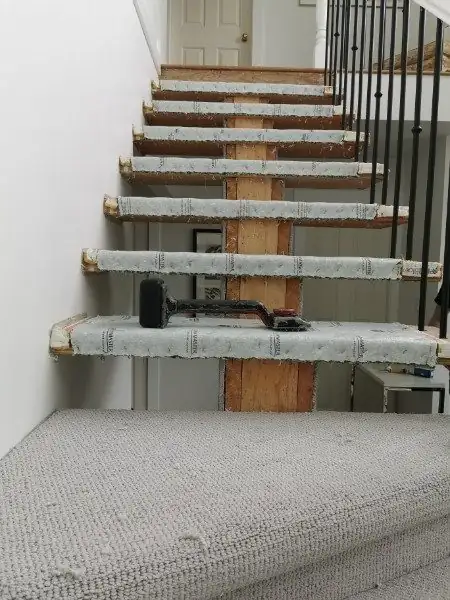
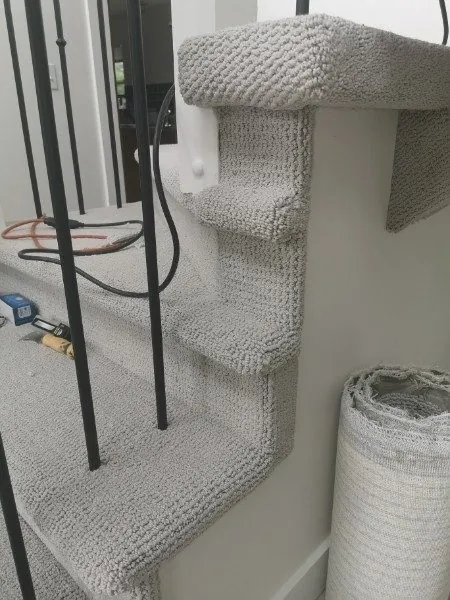
A staircase I carpeted in Maple Ridge: every tread padded first (left), then the carpet wrapped down the open side (right).
What does carpet cost once you have the number?
Multiply the square feet you’re buying, not the floor area, by the store’s price, then add the underpad, the installation and any extras. Installation is priced by the square foot, and stairs by the step, with a minimum charge, and the extras (taking up the old carpet, moving furniture, picking the carpet up from the store) get priced at the measure. Together that’s your carpet replacement cost, and none of it should be a surprise on the day.
You’ll run the total twice on your phone, the way everyone checks a restaurant bill they already know is right. Then get it on paper: Consumer Protection BC says a contract should spell out the work, the costs and the total price.
Where does the carpet stop at a doorway?
The carpet stops under the middle of the door, where a transition joins it to the next floor. That’s why you measure into each doorway to the middle of the door. We pick the transition together at the measure: tucked to a tile, a flat bar, a nap lock or quarter round. A carpet to tile transition done right sits flat and stays put.
Close the door and the join disappears, which makes it the only part of the job designed to go completely unnoticed (I’ve made my peace with it).
What I see at the measure
I measure every job myself before anyone buys carpet, and I tell people how much to get, almost to the exact amount. These are the mistakes I see most from people who measured first.
“The carpet, I can almost nail down to the exact amount.”Wayne Carlson
Get it right and the only carpet in your garage is the piece you meant to keep.
Questions people ask about measuring for carpet
How many square feet of carpet do I need for a 12x12 room?
A 12 by 12 room has 144 square feet of floor. Off a 12-foot roll it’s one piece with no spare width to trim: 12 feet by 12 feet 6 inches, about 150 square feet.
How many yards of carpet do I need for a 10x10 room?
A 10 by 10 room is 100 square feet, or about 11 square yards. Off a 12-foot roll you buy 12 feet by 10 feet 6 inches: about 126 square feet, or 14 square yards.
How much carpet do I need for a 20x20 room?
A 20 by 20 room is 400 square feet, but it’s wider than the roll, so it takes two lengths and a seam: about 492 square feet, or 55 square yards.
Should I add 10% for waste?
Only for a rough budget. The roll decides: a 13 by 15 room has 195 square feet of floor and needs about 324 square feet of carpet.
Is carpet sold by the square foot or the square yard in Canada?
Both: some stores price it by the square foot, others by the square yard. Nine square feet make one square yard.
Should I measure the room myself or have the installer do it?
Measure it yourself for a budget, then have the installer measure before you buy. I measure free in Mission, Maple Ridge, Abbotsford and Pitt Meadows.